We are entering a period in which compute demand isn't merely determining the size of a cloud bill. It is determining how many power plants, transmission lines, substations, cooling systems and data centers have to be built. Heck, it’s determining if we will be able to see the night sky.
Let’s review some facts about data centers first…
The International Energy Agency expects global data-center electricity consumption to roughly double by 2030, reaching about 945 TWh per year. Data-center electricity demand is growing around 15% annually in its base case — more than four times the growth rate of electricity consumption in the rest of the economy. (IEA)
Lawrence Berkeley National Laboratory estimates that data centers consumed about 176 TWh in 2023, or 4.4% of all U.S. electricity. By 2028, that could reach 325 to 580 TWh — between 6.7% and 12% of U.S. electricity consumption. (Berkeley Lab News Center)
A newer Berkeley Lab analysis puts the reference-case estimate at 649 TWh in 2030, with plausible scenarios ranging from 521 to 843 TWh. Importantly, one of the variables materially changing that forecast is simply how much equipment gets installed and how heavily servers consume power while operating or idle. (LBL ETA Publications)
Data centers aren't abstract clouds, they are factories for computation, and factories need power. This is kind of like the industrial revolution where smelting plants started taking over farmland… it just seems cleaner because we don’t see Hyperion out in the middle of a soybean field (Hyperion, btw, is about the size of MANHATTAN).
Turns out, the bottleneck in data-center construction increasingly isn't land or concrete even though concrete and steel are getting more expensive.. the bottleneck is electricity.
CBRE calls power availability the foremost site-selection criterion for new greenfield data centers. It reports that developers are increasingly chasing enormous sites capable of supporting 200 MW or more, while individual projects are reaching 250, 500 and even 750+ MW. (CBRE)
Limited power is already pushing development out of traditional data-center markets and into places where electricity can be obtained faster. CBRE says power constraints are extending construction schedules into 2027 and beyond while demand continues to outstrip supply. (CBRE)
More compute requires more electrical capacity. More electrical capacity requires more substations, transmission, generation, cooling and land.
JLL estimates that the average cost to construct the shell and core of a data center has climbed from $7.7 million per MW in 2020 to $10.7 million in 2025, and forecasts $11.3 million per MW in 2026. And that figure doesn't include the servers.
And it gets worse when you look at the drive from AI infrastructure… JLL says the tenant technology fit-out can add as much as another $25 million per MW. (JLL). They also estimate that roughly $3 trillion of investment could be required to deliver 100 GW of new global data-center capacity by 2030. (JLL)
This is business 101… the opportunity cost is huge because the scale of this build out is huge. It eats up land, steel, concrete, and money. Even aside from the electricity that could be used to power homes, hospitals, schools or more esoteric things like water treatment or carbon filtering, by locking away all these resources in disposable buildings, other things won’t get done.
So.. a megawatt of demand you permanently eliminate isn't merely a smaller electricity bill. It’s $11.3 million dollars available for something else. If we can reduce sustained compute demand across enough workloads and we can reduce pressure for new physical capacity.
I’m not saying that this is all solvable with scale to zero – idle servers still burn power, still create heat the requires cooling, still need the racks and the infrastructure. Once those data centers are built, the cost is sunk in the infrastructure, the grid is being drained, even if we are draining it lower.
The goal is to slow down the NEED for those data centers by reducing our waste BEFORE they get build.
Berkeley Lab reported that reductions in its own high-performance computing loads were a major reason annual water consumption fell by 6.7 million gallons in one year. HPC systems consume water because their heat has to be removed. (Sustainability Annual Report 2025)
The Lab also demonstrated that optimizing supporting infrastructure can dramatically reduce resource consumption: one two-year project reduced non-IT data-center electricity use by 42%, saving more than 2 million kWh and roughly half a million gallons of water annually. (Berkeley Lab News Center)
Efficiency at every layer matters, but the flat-stack argument starts one layer earlier:
- Don't cool compute you didn't need to perform.
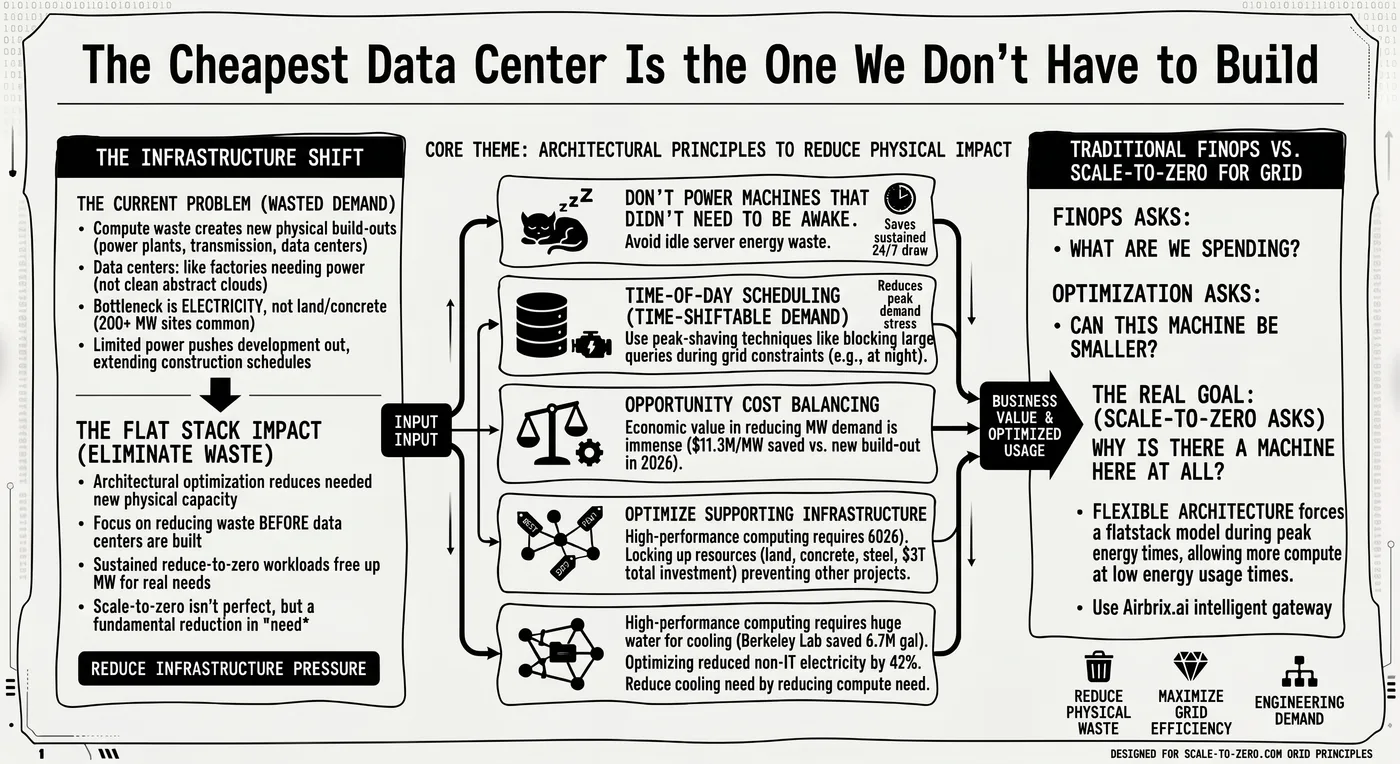
- Don't power machines that didn't need to be awake.
- Don't build infrastructure whose primary function is waiting.
There is another part of this conversation that traditional FinOps largely ignores. Electric systems aren't built around average consumption alone. They also have to withstand peak demand.
The IEA describes demand flexibility (reducing or shifting electricity use when the system is constrained) as a way to improve utilization of existing generation and grid infrastructure, lower system costs and reduce stress during peaks. (IEA)
Good architecture can force a flatstack model during peak energy times and allow higher compute and low energy consumption times. We do that with the Airbrix.ai intelligent gateway – time of day blocking of large complex queries mean that they can run at night when all the AC is quiet, when people aren’t running their TVs and dishwashers… when electricity is cheaper and compute is cheaper.
Those architectural decisions are tiny when viewed one request at a time but power grids don't see one request at a time… they see all of them.
Honestly, as much as I evangelize this, I know that scale-to-zero isn't going to magically cause data-center construction to stop. But... there is a simpler concept here:
For any given amount of useful digital work, doing it with less persistent compute requires less physical infrastructure than doing it with more.
Sure, if demand eventually overwhelms those savings, we’ll build another data center. But we'll build it later, or we’ll build fewer of them. Meanwhile we free up scarce megawatts for workloads that actually need them.
When construction is costing roughly $11 million per MW before much of the computing equipment is installed, "later" has considerable economic value. (JLL)
This is where the scale-to-zero argument diverges from ordinary cloud-cost optimization.
FinOps asks:
What are we spending?
Optimization asks:
Can this machine be smaller?
Scale-to-zero asks:
Why is there a machine here at all?
I think my sense of urgency on this is in part because AI has made software incredibly cheap to create, but AI isn’t lazy, it build big systems that would be really hard for a newbie developer to put in place, and that newbie developer has no idea how much compute they are really wasting.
But we can use that AI dev to do both: we can use that productivity to produce more software as the same time we use it to remove infrastructure.
The next great optimization may not be figuring out how to build data centers faster.
It may be figuring out how many of their computers we never needed to turn on.